
ARCHEOLOGY
10-01-2025 by Leni Frau

The ‘friends of Lucy’, the first woman in the history of human beings in the world, who lived at least 3 million years ago and whose remains were found on the border between Kenya and Ethiopia, were in the Homa Bay area on Lake Victoria and made ‘advanced’ tools.
The new research, carried out by the City University of New York, has illustrated an incredible find, which increasingly confirms that Kenya is the ‘cradle of civilisations’ and not only that of mankind, with the first hominids. On the lake peninsula of Homa, archaeologists have in fact discovered an organised society that built what are believed to be among the first tools ever used on Earth. This was the community called the Oldowan, australopithecines to which Lucy also belonged.
Not only that, they were so well crafted that after more than 3 million years, they would still be usable, still having the handle intact and the edge sharpened.
Researcher Tom Plummer and his team found flakes, small knives and blades at the Nyanga archaeological dig site. According to the American University archaeologist, the blades were made by hammering one stone against another. The knives would have been used to peel and cut fruits and vegetables and to cut the meat of prey such as hippos.
The meat was then pounded between the stones to make it more tender. The knife and stones are known as the Oldowan toolkit and probably laid the foundation for further technological advances.
‘I think the production of Oldowan is probably the most important technological breakthrough ever in human history,’ Plummer told CBS.
The breakthrough for mankind is that the construction and use of such tools gave ancestors access for the first time to a whole range of foods that they had previously struggled to eat, or were unable to give to their children. Plummer said this new diet would have fuelled the growth of the body and brain, initiating a ‘feedback loop’ that created more sophisticated beings who ‘begin to do more with technology’.
Who made the tools is another surprise, which the archaeologists are still working to investigate. Along with the tools, in fact, Plummer's team found the tooth of a paranthropus, an early hominid that is not a direct ancestor of humans. This suggests that early tool-making is not a human inheritance, but an idea that mankind's ancestors copied and then used to dominate other hominids, who probably eventually became extinct.


by redazione

It is no coincidence that Kenya (or rather, East Africa) is considered the "cradle of humanity": here...
EVENTS
by Freddie del Curatolo

Prehistoric rock art is one of the least known but most fascinating cultural attractions of this country that...
by redazione

Kenya's potential in the field of archaeological research is well known, even if above all it is those of earth, mainly connected to the important findings that concern our proto-antheniated in the area of Lake Turkana.
TOURISM
by redazione

Malindi could be one of Africa's most important destinations for marine archeology.
In the depths off the north coast of Kenya are hidden secrets of over 2000 years of history.
It was already the Phoenicians, and then the ancient Romans, to...
WORDS OF AFRICA
by redazione

"Africa was the breath and life of my childhood. It is still the incarnation of my ...
NEWS
by redazione

It is a great day for Kenyan marine archaeology.
In Malindi, three experts from Italian seabed arrived at Malindi: Sebastiano Tusa, the Superintendent of the Sea of Sicily, and his two collaborators Claudio Di Franco and Fabio Di Iorio.
NEWS
by redazione

The event organized by the Italian Institute of Culture in Malindi tomorrow night will have as guest of honor the Ambassador of Italy in Nairobi Mauro Massoni.
The National Museum of the town, behind Uhuru Garden, will be inaugurated the...
SCIENCE
by redazione

If it is true that the remains of the first prehistoric woman have been found between Kenya and...
SHOWS
by Leni Frau

Freddie and Sbringo's animals return for the fourth week in a row to the Baby Marrow of...
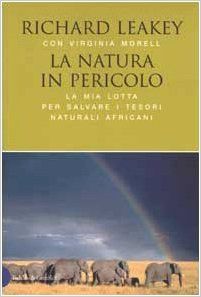
"My struggle to save Africa's natural treasures".
This is the eloquent subtitle of an autobiography written with four hands with the journalist Virginia Morell.
NEWS
by redazione

A great encore for the Italian violinist Francesco D'Orazio, who after having enchanted the audience at the National Museum of Malindi on Tuesday, two days ago he performed at the National Theatre in Nairobi, before an audience that for days...


