
KENYAN WRITERS
27-03-2026 by Freddie del Curatolo

Some might say that African nature, its warm and unfiltered people—true in every expression, for better or worse—and the intense sensations that rise from this land offer so many literary cues that there would be no need to invent anything at all.
And yet, for those who live here—especially the young—the pull of imagination can also be an escape from a reality that feels carved indelibly into tree trunks, into people’s skin, into ancestral rites and customs that, in some ways, seem unchangeable.
That is why writers like Wilfred Bundi Njeru are born.
Born in 1996, on a morning he himself might call “fateful,” beneath the concave sky of Kerugoya in Kirinyaga County, north of Nairobi, Njeru is one of those young men who chose not to simply tell Africa as it is, but to reinvent it without betraying it.
Raised in the village of Mbiri, among red roads and landscapes that already feel like they belong to a novel, he did what many dream of and few dare: he took myths, legends, and oral stories and pushed them further, into a parallel world.
Now based in Nairobi, he doesn’t write merely to escape. He writes to reshuffle the deck. Because if reality already feels written, then you might as well change its alphabet.
So in 2020, ARIKANA was born—a small act of linguistic rebellion in itself: AFRIKANA without the “F,” as if something had been removed, or perhaps set free. An African fantasy saga that does not imitate Tolkien nor chase the West, but instead sinks its hands into the continent’s history, kingdoms, symbols, and fears, turning them into epic.
The first chapter, Son of Akanga (2023), takes the reader into a land where ancient gods and dark sorcery contend for the fate of seven kingdoms, where invasions and prophecies intertwine with family drama and impossible choices. The second, Guerrilla Queen (2025), raises the stakes: dethroned queens, slavery, unlikely alliances, and destinies running side by side without yet recognizing each other. The trilogy will be completed with Day of the Dark Sun, soon to be released.
In between, there is a world that resembles Kenya but is not Kenya—and perhaps for that very reason, tells it better.
It is no coincidence that his books have made their way to the Library of Congress and into the libraries of universities such as Columbia, Stanford, and Princeton. There is something quietly striking about stories born between Mbiri and Nairobi, between dust and imagination, now resting on the shelves of institutions that for years looked at Africa more as an object of study than as a source of its own storytelling.
And yet, Njeru does not seem in a hurry to prove anything to anyone. If anything, he feels like one of those who write because they simply cannot help it. Because in the end, even when everything around seems still, there is always a young man looking at the same landscape and deciding that no, it is not enough as it is.
So he rewrites it.
Malindikenya.net met and interviewed Wilfred.
1. How did you become passionate about writing, what school did you attend, and where did you learn the art of writing?
It started with an idea. One I couldn’t let go of. I probably shouldn’t be writing. I went to engineering school for 3 years, a bout that did not require my artistic side much. After a tough High School experience, the easiest way to escape for me was being creative.
Dancing, Music, drawing, and then Writing.
I think, writing was more of a necessity for me. It wasn’t enough writing for exams, so I started expressing what couldn’t fit on school papers on other places. I made comicstrips and novellas in my spare time, pieces that ended up circulating the entire school.
These were early makings of what is today, Arikana Books.
Through the scraps of paper and imitating book making, I discovered that I had stories to tell. If I had enough understanding, I would probably have started with films. I started with what I knew to do. Write!
2. It is said that to become a writer, you need to read much more than you write. What were the first novels you became passionate about, and which writers do you think you learned the most from and who inspire you?
To state but a few, Adventures of Thiga by C. M. Mureithi, Tales of Wamugumo by Peter Ngibuni – the works of Phoenix Publishers, Pacesetters, and a vast collection of books my father kept in his home library. Today, Tolkien, perhaps stands tall in my thinking of an author committed to a lifetime of work.
3. Many writers in Kenya have always drawn inspiration from reality, often from their own personal experiences, to tell stories, perhaps using social commentary, drama, or even irony to capture the reader's attention. You have chosen an unusual genre for Africa: fantasy. Where did this choice come from?
Fantasy is unusual, but in a good way.
When we think about reality, a good adventure is a great way to escape. To go the distance and show good triumph over evil. It satisfies an old belief we all have, that there is victory in the end.
I think the things we face in life can push us to the edge, but we need a little hope, bottled in a narrative that captures an alternative world equally troubled, but vastly elevated.
I use the tool of make believe, insired by Kenyan Mythology, to bridge familiarity in systems of power and Justive, Faith, and the human condition – to explore our moral failures in how we interprete villainy and heroism. To challenge our self-righteousness and hypocrisies.
It is not something I chose at first. I think it is a higher calling in and of itself. The urge to write 10s of thousands of words, build a world, and see a narrative go forward is laborious, but the reward of it has been remarkable!
4. After your trilogy, what projects do you have in mind?
Glad you asked.
There is a story I want to tell, but not in book form. I want to tell it as mini-episodes. I want to explore surrealism. I want to push it to a place where it feels dreadful and exciting for the mind. So yes, Arikana is what I am pouring into in the near future, but TV and FILM excites me!
I also have a sci-fi novel idea that remains very personal to me, and it might actually be the first thing I jump into after ARIKANA is wrapped.


It comes out these days in Italy the new novel by writer and director of Malindikenya.net Freddie del Curatolo.
The news, if you will, is that this time no mention of Kenya and Malindi.
It is in fact a story...
ITALIAN PODCAST
by Freddie del Curatolo

In this latest episode of the rotopodcast ‘Africa Does Not Exist’, for the feature ‘Claudia’s Books’, we...
by Freddie del Curatolo

The greatest Kenyan writer of all time, one of Africa's most celebrated authors and a multiple...
ROTOPODCAST
by redazione

The second instalment of African literature is now online, as part...
ITALIAN CULTURE
by Freddie del Curatolo

There’s no better way to celebrate a language than to meet those who have lived it, explored...
ROTOPODCAST
by redazione

There is one book which, more than many others, has helped to shape the romantic image...
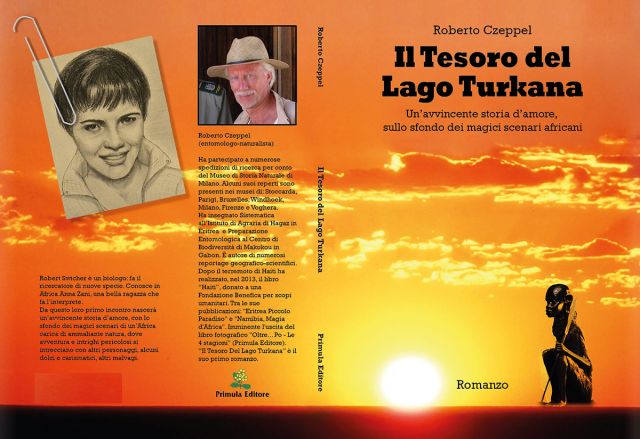
On Thursday, Nov. 1, at 7 p.m., entomologist and writer Roberto Czeppel, a leading expert on Africa, will...
BOOKS
by Freddie del Curatolo

Ngugi Wa Thiong'o is surely the greatest Kenyan writer of all time.
He has been included several times in the five nominations for the Nobel Prize for Literature and...
EVENTS
by redazione

On Thursday 21 March at 10 am, at the National Museum in Malindi, the Italian Cultural...
CULTURE
by redazione

From Bob Dylan to a Kenyan writer.
It would have been nice, also because the intellectual, poet, essayist and university professor Ngugi wa Thiong' or chase the Nobel Prize for Literature since 2012.
MOURNING
by Freddie del Curatolo

This has been a year of heavy losses for Kenyan literature....

John Le Carré, well-known and appreciated writer of "spy stories" with social implications, has set his novel "The Tenacious Gardener" in Kenya, between the banks of Turkana and the slums of Nairobi.

On 21 May 2019 he prematurely left us one of the greatest Kenyan writers and one of the most lucid, passionate...


