
24-06-2026 by Michele Senici

In Diani, just as in Nyali, two people were nearly killed over the past week on the same charge: making a man’s genitals disappear with a simple wave.
In both cases, the reaction was immediate; a crowd gathered and violence erupted before anyone could verify what had actually happened. Written like this, the sentence sounds like something out of a surreal story.
Yet it’s a news story. A story I spent three days grappling with, trying to sink my teeth into it, to chew it over to make sense of it—but to no avail. Because I’ve always been convinced that to write a piece, one must first chew over and digest the content; here, however, the news story is the only starting point. And perhaps even a lifeline. But just a few days earlier, the same scenario had already played out further south, in the rural areas near the border with Tanzania. This time, the victim was a man who had just crossed the border. It seems these fears spread like wildfire across makuti roofs. The police intervened; there were arrests and some rescues, but the atmosphere—at least for me—remains at times heavy, difficult to dispel.
The issue is complex, and many questions remain unanswered; one commitment I’ve made to myself, however, is to resist the urge to oversimplify. I don’t think it’s enough to dismiss everything as superstition, belief, or ignorance: that would be too convenient an explanation, but it’s not enough to stop at mere astonishment either. Because what strikes me in these episodes is not just the belief itself, but the speed with which an individual conviction becomes a collective reality. A man shouts that his genitals have disappeared, and within moments, the crowd grabs stones and sticks. The sudden shift from a gesture, a sensation, a fear, to a shared truth that no longer needs to be verified. It is in that shift that something broke.
No one stopped to verify the accusation or to question it. The crowd consisted of those who believed it, those who perhaps didn’t but thought “better safe than sorry,” and those who had simply had a bad morning and were brimming with anger they needed to vent. There was certainly someone filming the scene, because today these images have already appeared on screens, where other crowds comment that they could never act that way. But the dynamic doesn’t change much when the crowd is digital rather than physical: all it takes is a story, an accusation, an image, for the reaction to spread at the same speed, until it turns into a collective judgment even before any verification takes place.
But what remains today of these special tribunals—of the bonfires in Diani and their digital counterparts—are the injured bodies, the people dragged into a conviction that wasn’t their own, and a community that always wakes up a moment too late, when everything has already happened. And perhaps this is what makes these scenes so difficult to watch: not the absurdity of the accusation, but the matter-of-fact way in which a crowd can convince itself that it is acting justly. These are episodes that make us uncomfortable precisely because they do not belong to some distant place: they occur within human dynamics that each of us is familiar with, and that can turn into action much more quickly than we are able to recognize them.
••• Michele Senici, 1993. Educator, teacher, project coordinator. I opened Casa Hera in Diani because I didn’t know where to continue my life. Do I understand it now? Certainly not, but that’s okay—at least I observe, think, and write.


CORONAVIRUS
by redazione

Just when the Government of Kenya seems to have decided to reopen the country, next ...
by Leni Frau

In Kenya and Tanzania, there is no peace for owls either.
In addition...
KENYA NEWS
by Freddie del Curatolo

On the Kenyan coast, there are things that progress has never managed to displace. They...
FOREST
by Freddie del Curatolo

In the midst of Dante's celebrations, I found myself in a not-so-dark forest where the straight path was...
MAL D'AFRIQUE
by redazione

This space is dedicated to all the people who had to do with Kenya, on holiday, for job, guests of a friend, for voluntary service or by any other voluntary or unintentional chances, and who experienced so much the magic...
VIDEO
by Freddie del Curatolo

Il tocco dello Sciamano' (The Shaman's Touch) is a very interesting documentary shot in Kenya, as well as...
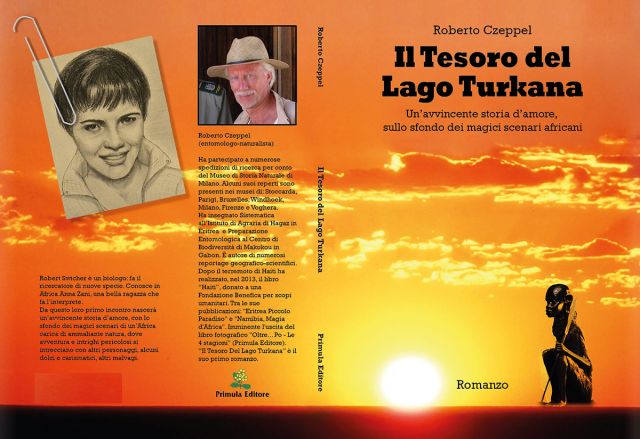
On Thursday, Nov. 1, at 7 p.m., entomologist and writer Roberto Czeppel, a leading expert on Africa, will...

The last seizure took place yesterday in Vietnam, a hundred pounds of rhino horns from Kenya, reports the sad topicality smuggling related to protected species of the African savannah.
The battle against poachers who kill elephants also proceeds with encouraging...
EVENTS
by redazione

Sipping an excellent cocktail a stone's throw from the sea, while the setting sun reflects its...


