
INSIDE KENYA
25-11-2026 by Freddie del Curatolo
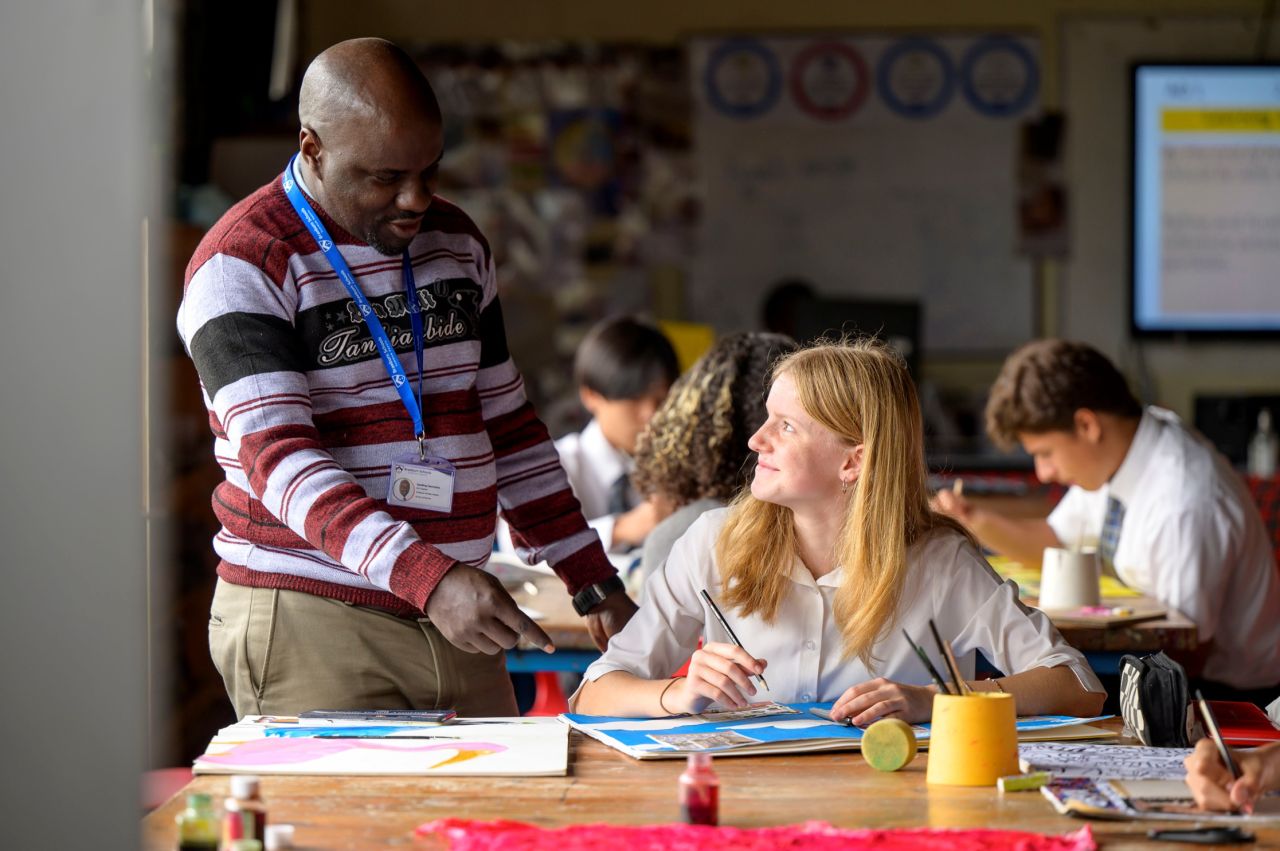
How much is a high-quality education worth in Kenya? It depends on what is meant by ‘high-quality’, on the chosen curriculum and, above all, on the family’s bank balance. In the country’s private and international schools, annual fees range from less than 200,000 shillings to figures that can exceed four million. It is a complex landscape, in which different educational models coexist alongside a growing demand for an education that is also recognised abroad.
According to data published by InternationalSchools.net, which compiles fees from 31 Kenyan international schools with fees quoted in local currency, the annual cost of education ranges from 150,000 to around 2.93 million shillings. Calculating the median of the central values of each school’s fees yields a figure of approximately 940,000 shillings per year.
This is a significant figure: we are talking about almost one million shillings – around 7,300 dollars – for a single academic year. For a Kenyan family on an average income, this can represent an expense that is difficult to sustain.
The picture is even broader when considering individual classes and schools with particularly high fees. Some schools charge over four million shillings, whilst others, particularly those outside Nairobi’s most exclusive areas, remain below 500,000.
It should be noted that these are the published school fees, not necessarily the total cost: enrolment, exams, transport, meals, uniforms, books, extracurricular activities and, above all, boarding may incur additional expenses.
The same database also provides a breakdown by price bracket: low (up to 606,500 shillings), medium (from 606,500 to 964,500) and high (over 964,500 shillings).
Different curricula: there is no single international school
One of the characteristics of private education in Kenya is the variety of teaching programmes. Not all international schools follow the same path, and the choice of curriculum can influence both the teaching method and the type of qualification awarded.
- Cambridge International: this is one of the most widespread programmes. Of British origin, it offers a programme leading up to the IGCSE exams, generally taken between the ages of 14 and 16, and subsequently to A-Levels. It is particularly popular with families who wish to keep open the option of enrolling their children at British and international universities.
- British National Curriculum: this follows the English school system, organised into Key Stages, with a programme covering primary and secondary education. It is often combined with Cambridge or Pearson Edexcel examinations.
- International Baccalaureate (IB): this is an international programme divided into several stages, from early childhood to the final diploma. It focuses on multidisciplinary education, critical thinking, independent research and an international dimension to learning. It is particularly common in high-end schools.
- American Curriculum: this follows the US model, with levels ranging from nursery school to high school and leading to an American school-leaving certificate. In some schools, the programme also includes Advanced Placement (AP) courses and preparation for entrance exams to American universities.
- Pearson Edexcel: this is another British system, offered as an alternative or complement to Cambridge, which provides international qualifications and GCSE and A-Level courses.
- Montessori: rather than a comprehensive school curriculum, this is a pedagogical approach, particularly widespread in the early years of education, based on autonomy, hands-on learning and the child’s individual pace.
Alongside these programmes is, of course, the Kenyan national curriculum, the CBC (Competency-Based Curriculum), now also known as CBE, which constitutes the country’s official curriculum. It is organised according to a 2-6-3-3 structure: two years of pre-primary, six of primary, three of junior school and three of senior school.
The CBC places less emphasis on rote learning and more on skills, the ability to apply knowledge, creativity and practical training. Several private schools also adopt it, sometimes alongside international programmes.
How much do schools on the coast cost?
This overview is not limited to Nairobi, where most of the most prestigious schools are concentrated. There is also an international school offering on the coast, which appeals to affluent Kenyan families, resident foreigners and expatriate communities.
In Malindi, for example, Light International School offers the Cambridge curriculum, with annual fees ranging from 176,400 to 556,500 shillings for the programme listed in the 2026–27 price list. This is one of the most affordable options among the international schools surveyed.
In Mombasa, by contrast, Light International School charges between 283,500 and 840,000 shillings, whilst Braeburn Mombasa International School reaches a fee bracket exceeding 1.36 million. The Coast Academy, based in Mombasa, offers a Cambridge curriculum with fees ranging from 165,000 to 1.02 million shillings.
Even along the coast, therefore, the differences are significant. The presence of an international curriculum does not automatically mean a school falls into the most expensive bracket: tuition fees are also determined by the academic standard, the facilities, the teacher-pupil ratio and the services offered.
The club of schools charging millions of shillings
Moving up a tier takes you into a decidedly different world. Among the most expensive schools is Peponi School, with fees for older pupils reaching 2,929,110 shillings per year for day pupils and up to 4,361,610 depending on the year group and the rates listed in the database.
Peponi House, Brookhouse School, The Banda School, Braeburn School and the Aga Khan Academy also belong to the most exclusive segment of Kenyan private education.
At these institutions, the fees do not merely cover teaching hours. Depending on the school, they include science laboratories, libraries, sports facilities, swimming pools, playgrounds, arts programmes, musical activities, foreign languages and a network of international connections.
The education is often designed to support pupils right through to entry into foreign universities, with guidance and preparation programmes for admissions. This is also one of the factors that makes the sector attractive to families with high disposable incomes.
An investment in education, but also in social status
The success of private and international schools in Kenya can also be explained by a matter of trust. Many affluent families prefer to entrust their children’s education to institutions that guarantee smaller class sizes, greater teacher availability, adequate facilities and a school curriculum recognised even beyond national borders.
For families of entrepreneurs, diplomats, foreign professionals and executives of large companies, an international school often represents a strategic choice. A Cambridge, IB or American school-leaving certificate can facilitate further study in Europe, the United States or other countries.
But it would be simplistic to think that this phenomenon concerns only foreigners. A significant proportion of the demand comes from the Kenyan middle class itself, from families who regard private education as a priority investment, sometimes sacrificing other expenses in order to guarantee their children an educational pathway considered more competitive.
There is, of course, also a vast array of Kenyan private schools that do not belong to the international circuit and follow the national curriculum, with significantly lower fees. The private sector, therefore, is not synonymous with ‘luxury’ schools, just as high fees do not automatically guarantee educational quality.
However, a clear social issue remains. In a country where access to high-quality state education and educational opportunities is uneven, the ability to choose between different international programmes risks becoming a further factor driving a divide between those who can afford to invest hundreds of thousands, or millions, of shillings a year and those who must make do with whatever is available.
The paradox is that Kenya, a young country with a rapidly growing population, needs to train an entire generation of professionals, technicians, researchers and entrepreneurs. Yet some of the most sought-after educational opportunities remain accessible mainly to those who can afford them.
And so, whilst the country debates development, innovation and its digital future, even a school desk has become an indicator of family income. For some children, the world begins with a blackboard and a teacher. For others, it begins with an international curriculum, a robotics lab and tuition fees running into several million shillings.


School examinations began this week in Kenya for 1.3 million Kenyan primary school students (primary...
EDUCATION
by Caroline Sabina Wekullo

The school completion rate has emerged as one of the most pressing issues facing education in Kenya...READ THE FULL ARTICLE HERE
https://theconversation.com/how-to-keep-kenyan-children-in-school-longer-its-not-only-about-money-157461
KENYA NEWS
by Freddie del Curatolo

This could be a crucial moment for education in Kenya...
SCUOLA
by Leni Frau

The last classes of Kenya's primary and secondary school will resume classes next Monday, 12 ...
NEWS
by redazione

After the controversy of recent days with the parents' associations of Kenyan students, Education ...

Thousands of students from various schools across the country are at risk of being sent...
SOLIDARITY
by redazione

Twelve years have passed since 25 September 2018, when in Piove di Sacco, in the Padua area...
STORIES
by Freddie del Curatolo

In Africa, education is often discussed as a problem of access: more schools, more classrooms, more
KENYA NEWS
by redazione

After Treasury Minister John Mbadi announced heavy cuts to education and the possibility that aid
EDUCATION
by Freddie del Curatolo

Nairobi has the most expensive international schools in the whole of...
KENYA NEWS
by Freddie del Curatolo

Today in Kenya, millions of pupils will return to school for the third and final term of the academic...
NEWS
by redazione

After protests from the Kenya Private Sector Alliance (KEPSA) and evidence of reduced availability of new...
by Leni Frau

The story of Susan Gaita, a fifteen years old girl of Pokomo ethnic group, is a common story unfortunately happens to many young people of the district of Malindi, but she has something more: it is very good at school...
EDUCATION
by redazione

The High Court has temporarily suspended the government's recent directive that would require...


