
TRADE
31-10-2026 by Freddie del Curatolo
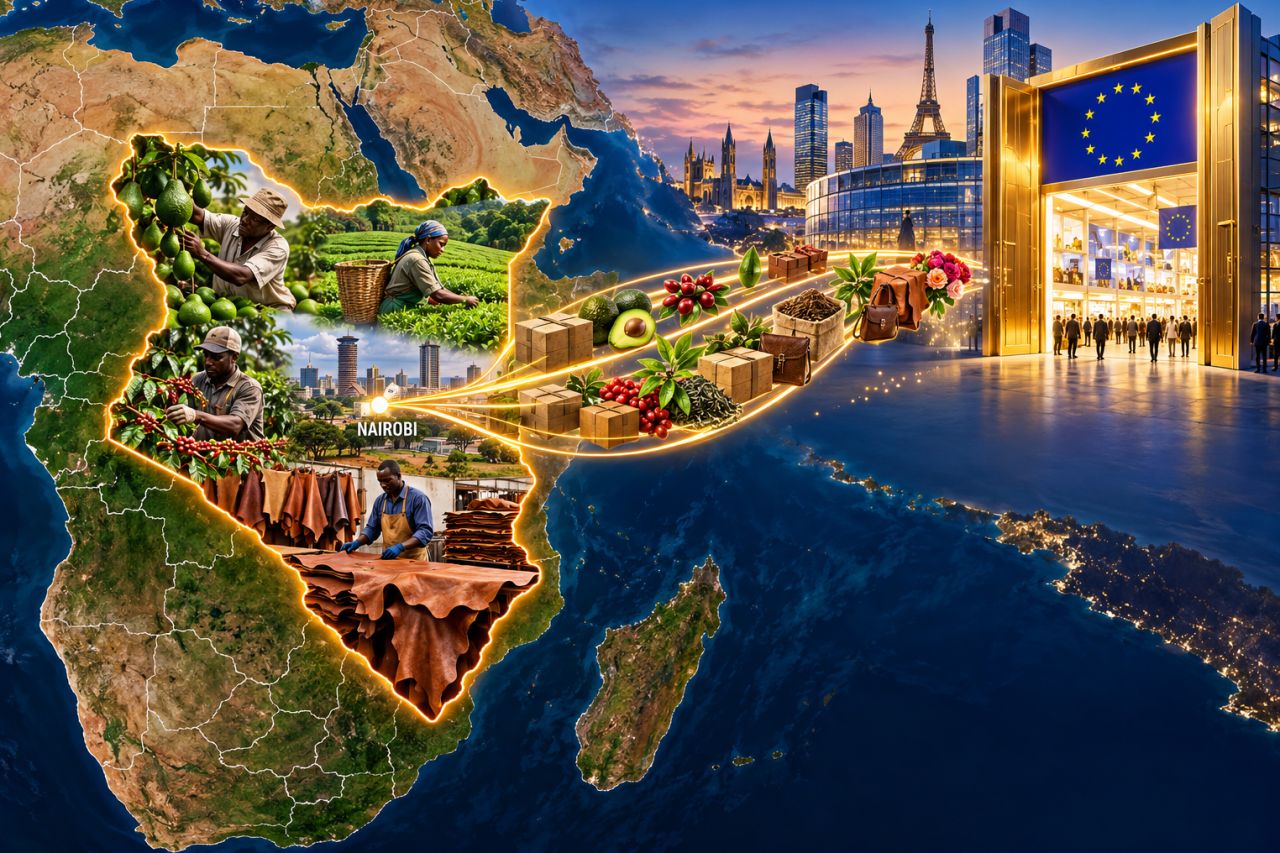
The market is there, the products are there too, and the tariffs have been lifted. Yet Kenya manages to capitalise on barely a tenth of the trade opportunities offered by the European Union. A picture that reveals much more than just a simple export problem.
In short, Kenya could export far more to Europe, but for now it seems unsure of how to go about it. This is the picture that has emerged from the latest statements by the Kenya Association of Manufacturers (KAM), according to which the country is utilising just 10 per cent of the trade opportunities available in the European Union market, despite the agreement guaranteeing Kenyan products duty-free access with no quantitative restrictions.
This is a surprising figure, especially considering that the economic agreement between Nairobi and Brussels, which came into force on 1 July 2024, was supposed to mark a turning point for local businesses. Today, Kenyan exports to the EU are worth around 264 billion shillings, but, according to Tobias Alando, KAM’s chief executive, this is only a fraction of what the country could potentially sell to the 27 Member States.
Alando spoke at the launch of the Kenya-EU Export Catalogue 2026, a new catalogue designed to connect Kenyan producers with European importers, providing information on available products, target markets and the requirements for exporting.
According to the head of the manufacturers’ association, the main obstacle is precisely the lack of information. Many companies do not know how to identify European buyers, are unaware of the specifications required by individual markets, and are not sufficiently prepared to meet the conditions necessary to enter them.
But is it really just a question of information?
The agreement with the European Union has effectively removed a major barrier: from July 2024, products of Kenyan origin can enter the European market without paying customs duties and without quantitative quotas, provided they comply with the rules set out in the agreement.
However, removing duties does not automatically make products competitive.
Europe has particularly strict rules on food safety, phytosanitary certification, traceability, quality, labelling and customs procedures. To sell fruit and vegetables, for example, it is not enough simply to grow and ship them: one must be able to demonstrate where they were grown, how they were treated, who worked in the fields, and how they were stored and packaged.
These are conditions that can prove difficult to meet, particularly for small-scale farmers, who make up a significant part of Kenya’s agricultural sector.
This issue was already highlighted in 2024 by a report on non-tariff trade barriers, which identified certifications, rules of origin and phytosanitary controls as some of the main obstacles to Kenyan exports.
But there is also a structural issue. The question that naturally arises is why, after decades of trade relations with Europe and with such a favourable agreement, Kenya has not yet developed a more efficient export network.
There could be several explanations.
Fragmentation of production: many farmers operate on a small scale and are unable to guarantee consistent, uniform and sufficient supplies for large international buyers.
Lack of industrial processing: Kenya continues to export mainly traditional agricultural products, whilst a significant portion of the added value could come from processing and value-adding these products before sale.
The cost of certification: meeting and maintaining the standards required by Europe involves investments that not all businesses can afford.
Logistics: transport, the cold chain, storage and delivery times have a significant impact on competitiveness, particularly for perishable goods.
Access to credit: without adequate financing, many companies cannot invest in machinery, facilities, certification and production capacity.
The difficulty of finding buyers: having an exportable product does not automatically mean having a sales network capable of distributing it in Germany, Italy, France or other European countries.
There is also an aspect that directly concerns the government’s economic policies: to turn a trade agreement into a concrete opportunity, infrastructure, training, business support and economic diplomacy capable of working daily to open up markets are required.
It is no coincidence that, during the presentation of the catalogue, the Ministry of Foreign Affairs announced its intention to involve Kenyan diplomatic missions more closely in the search for buyers, the gathering of commercial information and the matching of local companies with European partners.
The problem, therefore, does not seem to be an absolute lack of products or commercial opportunities. It is the ability to organise a system that makes them competitive and brings them to the European consumer.
There is one final statistic that makes the issue even more interesting. Before the agreement came into force in 2024, Kenya had exported goods worth approximately $1.2 billion to the European Union, whilst importing goods worth $1.9 billion. This represents a trade deficit of around $700 million, which growth in exports could help to reduce.
Europe therefore represents not only an export market but also an opportunity to rebalance a trade relationship in which Kenya still buys far more than it manages to sell.
And a fundamental question remains: how is it possible that a country with a strategic geographical location, an agricultural sector of international significance, a young population and a well-established trading tradition continues to make so little use of a market that has been practically opened up to it?
The answer cannot simply be that entrepreneurs are unfamiliar with European buyers. For whilst it is true that more information is needed, it is equally true that investment, organisation, industrial capacity and an economic vision that goes beyond merely celebrating signed agreements are required.
The risk is that Kenya will continue to be a country rich in potential, yet all too often unable to transform that potential into real wealth. And that, whilst new agreements are announced and catalogues are launched, 90 per cent of opportunities still remain out of reach.


TRADE
by redazione

The process that led to the Economic Partnership Agreement between the European Union and...
ECONOMICS
by Freddie del Curatolo

Kenya is one of the countries in Africa least taxed by the US government, and also...

Another step towards the abolition of tax barriers and the implementation of bilateral agreements...
ECONOMICS
by Freddie del Curatolo
From now on, it will be possible from Kenya to export products to 27 European Union countries duty-free, to...
COMMERCE
by Freddie del Curatolo

Ever closer ties, mutual facilitation of trade, and the development of digital technologies and services to...
ECONOMICS
by redazione

The Central Bank of Kenya (CBK) revealed in recent days that the Kenyan shilling is...
POLITICS
by Freddie del Curatolo

Kenyan President William Ruto concluded his visit to Italy, where in addition to the Italy-Africa summit he...
NEWS
by Leni Frau

Putin's Russia's war on Ukraine could create many more problems for Kenya than we...
CELEBRATIONS
by Freddie del Curatolo

One of the most beautiful settings ever, as far as Kenya's 2 June celebrations are concerned, by...

In Malindi, in the central shopping street Lamu Road, a stone's throw from banks, bars and...
MADE IN ITALY IN KENYA
by Freddie del Curatolo

For the third consecutive year, Kenya has provided an exceptional showcase for our excellent...
MADE IN ITALY
by Freddie del Curatolo

Italian wine is increasingly at the center of interest in the Kenyan market. Following the great...


