
EDITORIAL
22-10-2026 by Freddie del Curatolo
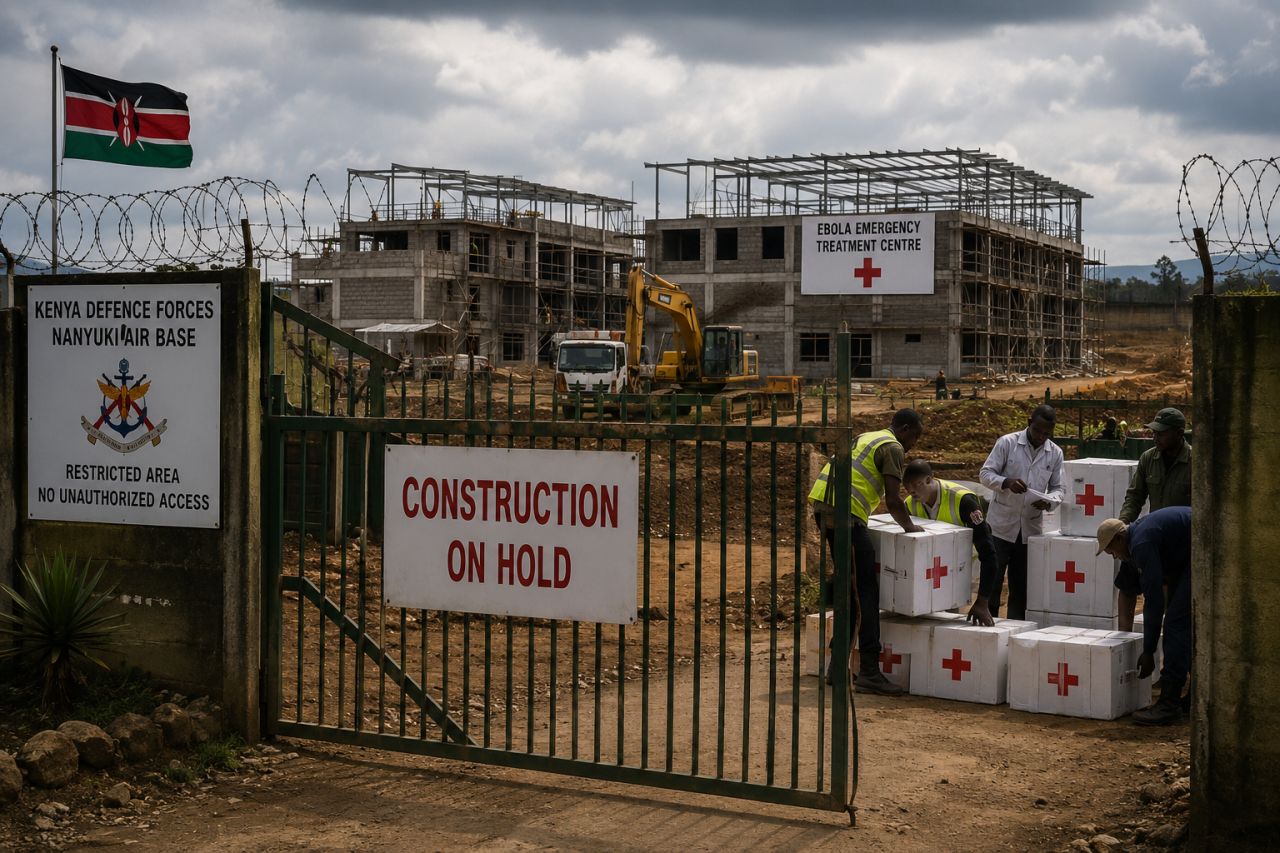
Kenya is safe enough to host a facility designed to assist American citizens potentially exposed to Ebola, but not safe enough to be recommended to those same Americans as a travel destination. This is the paradox surrounding the alleged health emergency in the country, where plans for a U.S.-backed quarantine center are intertwined with Washington’s heightened alert.
Kenya thus finds itself at the center of a contradiction that goes beyond the health dimension. The U.S.-backed project to build a quarantine facility at the Laikipia Air Base, in the Nanyuki area, is intended to accommodate U.S. citizens who may have been exposed to Ebola while working in countries affected by the epidemic, particularly the Democratic Republic of the Congo.
The initiative had already sparked local controversy and protests, as well as a legal battle. The public has objected to the prospect of hosting such a facility on Kenyan soil, while authorities have had to address concerns regarding public health safety and the transparency of decision-making.
Now the situation has become even more complicated. The U.S. State Department has raised its travel advisory level for Kenya from 2 to 3, urging U.S. citizens to reconsider travel to the country. The advisory, updated on October 19, highlights a variety of risks, including crime, terrorism, kidnappings, civil unrest, road safety, and public health. Among the public health concerns cited is the presence of Bundibugyo Ebola in Kenya.
Level 3 does not constitute an absolute travel ban, but rather an official recommendation to carefully evaluate whether to travel.
Meanwhile, as a case of the virus has emerged in Nigeria, some countries on other continents—especially those aware that their public health systems are ill-prepared—are beginning to deny visas to Kenyan citizens, as happened, for example, to the well-known Kenyan CNN journalist Larry Madowo in El Salvador, in Central America.
The most sensitive issue for Kenya is perhaps that of trust. A healthcare facility designed to protect American personnel potentially exposed to the virus can be presented as part of international cooperation and efforts to strengthen the response to the epidemic. But its location on a military base, along with local protests and the ensuing controversy, risks fueling the suspicion that the protection needs of foreigners are being prioritized over the concerns of the surrounding communities.
The Risk to Tourism
For Kenya’s tourism sector, the U.S. travel advisory upgrade represents yet another public relations challenge. Kenya thrives on its international reputation—from the beaches of the Indian Ocean to safaris in its national parks—and any official advisory from a major tourism market can influence the decisions of those planning a vacation.
It is necessary, however, to interpret the U.S. statement correctly. Level 3 applies to the country as a whole and encompasses various reasons; it does not mean that every location poses the same level of risk, nor that a blanket entry ban has been imposed. Furthermore, the alert does not pertain exclusively to Ebola, but also to security concerns already noted in U.S. assessments.
The fact remains that, while the Kenyan government seeks to reassure citizens and visitors about its ability to contain the outbreak, the country’s image is caught between the health emergency, the controversy surrounding the facility in Nanyuki, and the warning from one of its most important international partners.
Kenya must demonstrate that it can control the epidemic and, at the same time, ensure transparency and protection for the affected communities. Because in managing an emergency like Ebola, it is not enough to contain the virus: it is also necessary to prevent fear, misinformation, and mistrust from becoming a second outbreak—one that is much more difficult to isolate.


KENYA NEWS
by Freddie del Curatolo
After three weeks of waiting and health checks, the first 20 close contacts of people infected with...
KENYA NEWS
by Freddie del Curatolo

Whilst confirmed cases of Ebola in the Democratic Republic of the Congo have exceeded a...
KENYA NEWS
by Freddie del Curatolo

Ebola has never been seen in these parts. Not a single case. And yet, on the slopes of Mount Kenya...

Whilst protests are taking place in Nanyuki against the planned Ebola isolation centre and Parliament is...
KENYA NEWS
by Freddie del Curatolo
Kenya no longer has any patients undergoing treatment for Ebola or people in quarantine; it has begun...
LATEST NEWS
by Freddie del Curatolo

For months, Kenya has been looking westwards, towards the Congo and Uganda, just as...
by Freddie del Curatolo

Sometimes the fear of a disease spreads faster than the disease itself. In Kenya, where not a single...
KENYA NEWS
by Freddie del Curatolo
For once, the figures seem to offer cause for hope. Five hundred and fifty-one people were tested within...
KENYA NEWS
by Freddie del Curatolo

Seven official cases may seem like a small number in a country with a population of...
EPIDEMIC
by Freddie del Curatolo

Every time Ebola breaks out in Central Africa, someone on the other side of the world cancels a trip...
KENYA NEWS
by Freddie del Curatolo
Kenya has recorded its second fatality from the Ebola outbreak. A 65-year-old woman, who had tested...

Within two weeks Kenya, like much of the rest of Africa, will be able to test for...
KENYA NEWS
by Freddie del Curatolo

For once, it seems that activists and human rights organisations have won. No...
KENYA NEWS
by Freddie del Curatolo

Fears over the spread of the Bundibugyo strain of the Ebola virus – which kills one in two of those infected...
KENYA NEWS
by Freddie del Curatolo
The virus knows no borders, but neither does fear, at a time when, as the Poet predicted: ‘those...
KENYA NEWS
by Freddie del Curatolo
The old proverb ‘no news is good news’ is one of many sayings that draw a common thread between...

