
MOURNING
09-12-2025 by Freddie del Curatolo

There are nights in Nairobi when the wind seems to carry with it an ancient mourning, a sigh that comes from the savannahs of Amboseli, from the red dust of Samburu, even from the shady corridors of the Marsabit Mountains. Last night, one of those winds blew stronger than usual: Dr Iain Douglas-Hamilton, visionary zoologist, father of modern African elephant conservation and founder of Save the Elephants, passed away after a long illness.
He was 83 years old and had a life worth the weight of entire herds, with their stories, their wounds and that mysterious wisdom that he tried to decipher for over sixty years.
He arrived in Africa as a young man, with the typical shyness of the Scots and the bright recklessness of twenty-somethings who believe that the world can still be fixed. At 23, when many of us were still arguing about which university to attend, he was already closely observing the matriarchs of the wild elephants of Lake Manyara, taking notes and trying to interpret silences and vibrations that no one before him had ever attempted to translate.
He was the first to understand that pachyderms are not just giants of memory: they are families, communities, networks of relationships as complex as ours but infinitely quieter, more elegant. And when he saw those same families collapse under the blows of poaching in the 1970s, he discovered his second vocation in life: no longer just to study elephants, but to defend them.
He was the one who documented, with data in hand, the massacre: half of African elephants killed in a decade.
His voice, which did not like the spotlight, ended up in international forums, and in 1989 he contributed to the historic decision to ban the global ivory trade. For many of us, he was a technician. For elephants, he was a beacon.
In 1993, he founded Save the Elephants, laying the foundation not for an organisation, but for a new idea of coexistence.
In Samburu, together with his Italian wife Oria Rocco, he created an open-air laboratory, an observatory where elephants were not numbers but individuals recognised by name: Echo, the famous matriarch of Amboseli; the little First Lady; the wise Cinnamon;
the males on their long journeys, whom he followed like a poet chasing his characters along dirt roads. He was among the first to understand that technology could be an ally of conservation. He put GPS collars on elephants that travelled along ancient routes, crossing rivers, villages and borders, and in doing so revealed to the world – and to governments – that political maps never correspond to natural ones.
Iain did not track points: he reconstructed lives.
When a new wave of poaching between 2010 and 2012 wiped out another 100,000 elephants, Iain returned to the fight, like an elderly warrior who cannot put down his spear. He spoke to the US Senate and contributed to the closure of domestic ivory markets, including China's. And in 2013, he co-founded the Elephant Crisis Fund, which now has 120 partners in 44 countries, more than 500 projects and over £30 million invested not in flags, but in ideas and communities capable of protecting animals in the field.
He was a man who was moved by a young researcher who understood for the first time the logic behind a herd's detour. A man who, in Samburu, spent hours talking to rangers, Turkana and Samburu elders, convinced that local wisdom was an ancient science to be integrated with modern science.
His books, written with Oria – Among the Elephants and Battle for the Elephants – remain milestones. The documentaries that followed him, from the beloved BBC to the latest portraits by Maramedia, show him as he really was: a practical dreamer, a scientist with the patience of a craftsman, a man capable of laughing loudly while knowing first-hand the fragility of the world.
' He was never happier, says Frank Pope, CEO of Save the Elephants and his son-in-law, than when he sat next to a young scientist looking at movement maps, trying to understand what was going through the elephants' minds. He always had that sparkle in his eyes.
The same sparkle that elephants recognise, it is said, when they see someone coming who considers them equals, not attractions.
Iain leaves behind Oria, his daughters Saba and Dudu, and six grandchildren who are already growing up with the uncomfortable yet beautiful idea that the world can be saved one step at a time. Like the slow, measured, deep steps of an elephant.
And he leaves us here to decipher a loss that is difficult to explain. Because when someone who has dedicated their life to looking into the eyes of Africa's oldest animals leaves, it is as if the continent itself holds its breath for a moment.
But his legacy remains. In the wildlife corridors he has traced, in the communities that believe in coexistence, in the scientists he has trained, in the rangers who patrol vast territories every night. And, above all, in the thousands of elephants that still roam free today.
May the earth – the red earth of Kenya that he loved – be light upon him.
And may his elephants, somewhere, greet him with that silent bow of the head that Iain knew how to read better than anyone else.


WILDLIFE
by Leni Frau
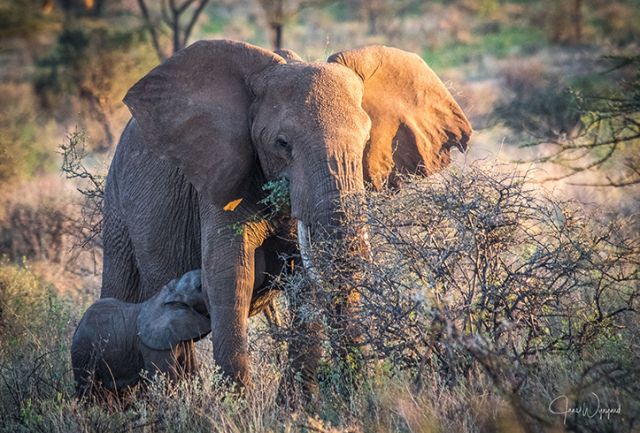
The story of the matriarch Monsoon, a female elephant from the Samburu region, is one to be told, to...
WILDLIFE
by Leni Frau
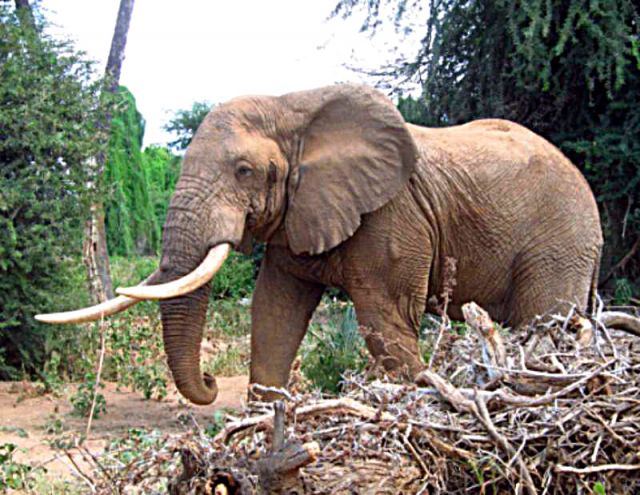
He died peacefully, for causes defined as natural by the experts of the association "Save the Elephant" in the ...
ITALIANS IN KENYA
by Freddie del Curatolo
WILDLIFE
by redazione

They say that an elephant never forgets – and apparently, it can also learn to adapt to...
AFRICAN WILDLIFE
by Freddie del Curatolo

Even Google has celebrated the legend of Ahmed, the glorious elephant considered to be the...
WILDLIFE
by redazione

African elephants are starting to be born without tusks, as a genetic protection to avoid being killed by...
NEWS
by redazione

More and more VIPs and billionaires are choosing Kenya for their holidays.
This...
CHANGE OF DIRECTION
by redazione

In a move announced by the Minister of Labor and Social Protection, Florence Bore, the...
WILDLIFE
by redazione

The figures presented by ICEA, Lion General Insurance Company at the Kenya Wildlife Service are clear, this year has reached the 100 mark lions killed in the bush of Kenya.
NEWS
by redazione

The highway that connects Malindi to the Tanzanian border, that is, to Lungalunga Customs, is no longer just an idea.
The 4-lane route that will connect on one side to the existing beautiful roads leading from the Tanzanian border to...
NEWS
by redazione

A small but significant help from the Italians in Malindi for the earthquake victims in central Italy.
As had been promised, were sent to the Italian Civil Protection the funds raised during the evening "Malindi for amateur" last September...
WILDLIFE
by redazione

Research by Colorado State University (CSU) scholars carried out in Kenya together with the organisations...
KENYA NEWS
by redazione

The anti-government protests and the degeneration of the demonstrations into clashes, violence...
NEWS
by Leni Frau

These are important days for the future of many young women from Kenya's Samburu tribes. Just before...


