
INSIDE KENYA
04-11-2026 by Freddie del Curatolo
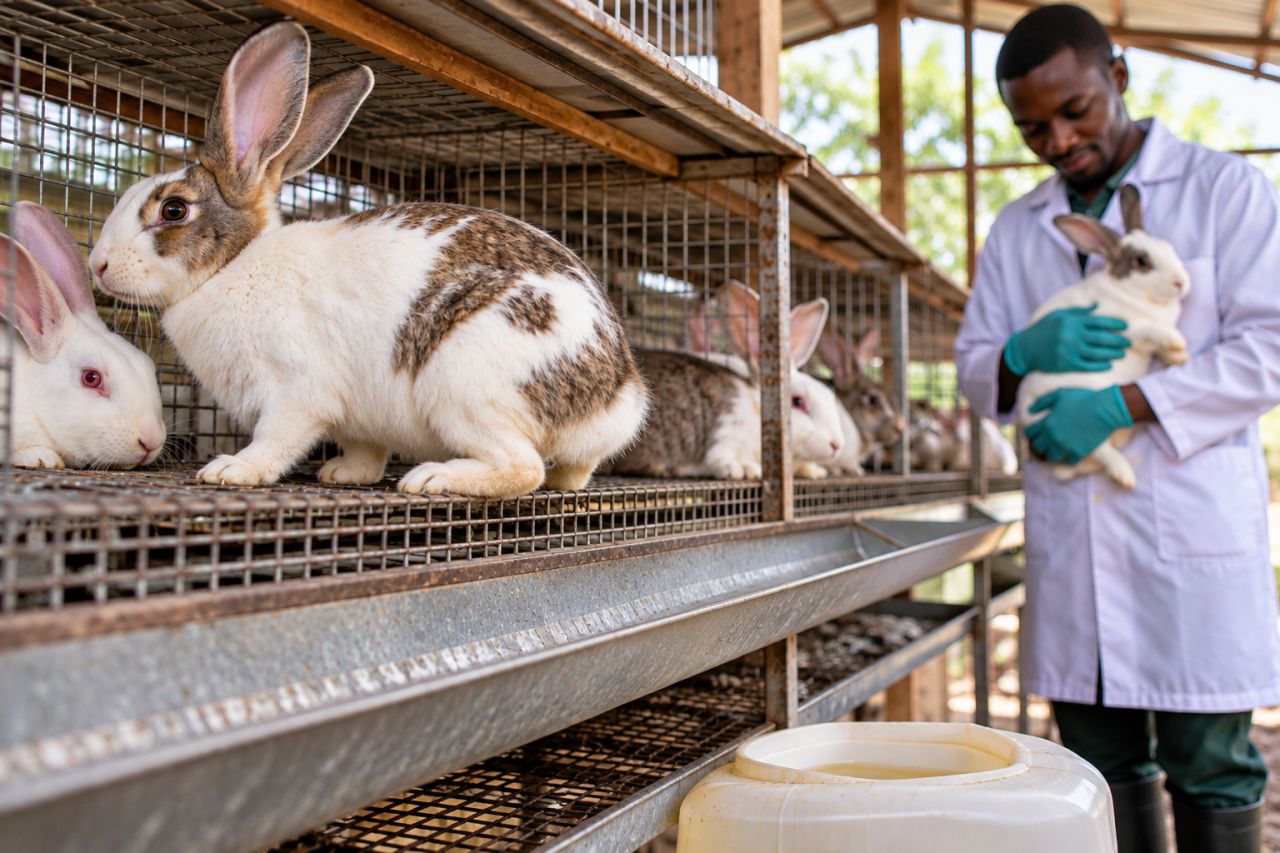
In the vast African economy of survival, even things that would normally be consigned to oblivion can find a new lease of life. And in Kenya, when people say that agriculture can turn anything into a resource, you have to take that quite literally. Even urine. Rabbit urine, to be precise, which in Njoro, in Nakuru County, has become a small business capable of adding a few shillings to the income of young agricultural entrepreneurs. And if anyone turns up their nose at the idea, perhaps they haven’t yet worked out the price per litre.
The Daily Nation newspaper reports on this curious initiative, having met the founders of Ubunifu Agri Enterprise, a company set up by young Kenyans who discovered that, as well as meat, rabbit farming can offer another commercial opportunity: the collection and sale of their urine, which is used in organic farming.
One of them, who holds a master’s degree in agribusiness management from Egerton University, had initially focused on rabbit meat. A product considered nutritious and relatively lean, but still not widely available in local butchers’ shops. Whilst travelling around Njoro, he realised that finding a specialist retailer was far from straightforward. Hence the idea of entering a supply chain that was still underdeveloped.
Then, as often happens when viewing a business through an entrepreneurial lens, a second insight struck: not just to sell the animal, but also to make use of its by-products.
Urine worth 100 shillings
The urine is collected via a system specifically designed for livestock farms. The cages have a perforated metal base, which allows solid waste to fall through whilst the liquid drains away. A sloping surface channels it towards a gutter, leading to a central collection point.
The system is not only ingenious but also meets hygiene requirements: keeping the animals dry and reducing product contamination. The urine is filtered, bottled and sold to local farmers.
The price is 100 Kenyan shillings per litre. A figure which, when considered in relation to a product normally regarded as waste, takes on particular significance.
The customers are mainly farmers from Njoro and Nakuru, but also include Greencom, a local organisation that uses rabbit urine as an ingredient in the production of organic fertilisers.
The product can be used on potato and bean crops, as well as having potential applications in plant nutrition and the management of certain harmful insects.
Fertiliser, repellent and agricultural alternative
Interest in rabbit urine is not entirely new in Kenya. In recent years, several farmers have begun to utilise it as a liquid fertiliser and potential biopesticide, at a time when the costs of agricultural inputs are placing an ever-greater burden on smallholdings.
The liquid contains nitrogen compounds and other nutrients beneficial to plants. Its composition, however, can vary depending on the animals’ diet and the methods of collection and storage. For this reason, it is not enough simply to fill a bottle and pour it onto the crops: correct dosages and appropriate treatments are required to avoid damaging the plants.
The supply chain may also be broader than it seems. On a well-organised farm, meat is the main product, urine becomes a commercial fertiliser and solid manure can be used as compost. It is a model that aims to reduce waste and derive value from every stage of production.
It’s not enough just to have a few rabbits
However, the work of Ubunifu Agri Enterprise shows that behind this curious trade lies more than just a bizarre idea. To make rabbit farming profitable, knowledge, facilities and careful management are required.
Diet is also crucial. Hay makes up around 70 per cent of the rabbits’ diet, supplemented by pellets, water and vegetables such as cabbage, Napier grass and sweet potato leaves. According to
Reproductive maturity is generally reached at around four or five months, allowing the number of animals to increase rapidly, provided the rearing conditions are appropriate.
The circular economy is also taking root here
The story of the young people from Njoro illustrates a small transformation in Kenya’s rural world. It is neither a technological revolution nor a major industry, but a different way of looking at the resources available. In a country where many young people are seeking employment opportunities and where agriculture continues to be one of the main sources of livelihood, even an unusual product can open up new avenues. In short, the rabbit is no longer just an animal reared for meat or kept in the backyard. It can become a small-scale production system, in which every component has value.
The circular economy, after all, can also have a rather distinctive smell.


KENYA NEWS
by redazione

Four young Sicilian tourists were victims of a road accident, fortunately without serious consequences...
NEWS
by redazione

Agriculture and food security, education and health, with a focus on education...
NEWS
by redazione

A new endless swarm of desert locusts threaten Kenya, but this time they have gone as ...
COOPERATION
by Freddie del Curatolo

Concrete help to the populations of one of the most troubled areas of Kenya, West Pokot, thanks...
SOLIDARITY
by Freddie del Curatolo

Often our vision of possible and constructive solidarity in Kenya matches that of ...
NEWS
by redazione

The future of travel to Kenya and from Kenya to Uganda will also be by rail.
The Kenyan...

The works on the Malindi waterfront is part of a much more complex aid plan for Malindi thanks ...
NEWS
by redazione

County lockdown in Nairobi and four other counties in Kenya.
This was decided...

Nakuru National Park is located in Kenya's Rift Valley Province, about 160 kilometers northwest of...


