
WILDLIFE STORIES
16-10-2026 by Freddie del Curatolo

Mother Nature has a terrible temper, an overprotectiveness that often turns to ferocity, but an extraordinary imagination. When all seems lost, when Death begins to take stock and the supposed guardians of Amboseli still haven’t quite worked out who or what poisoned eighteen elephants, she comes up with twins. As if to say: you’ve done enough damage; now let’s try to start afresh. It may not be enough, but at least she’s giving it a go.
Where the savannah stretches out at the foot of Kilimanjaro and elephants have always roamed the landscape with the solemnity of those who have nothing to prove to anyone, death has arrived in droves. Eighteen elephants have died in circumstances that have triggered investigations and raised the alarm. The analyses, as had previously been the case with some lions, have pointed to cyanide as a possible cause, but the origin of the substance and who is responsible have not yet been definitively established. Even nature, when questioned, sometimes refuses to testify.
And whilst we try to understand how this could have happened, something else has occurred in that very same ecosystem that seems to have been penned by an author too sentimental to be taken seriously, yet too skilful to be ignored.
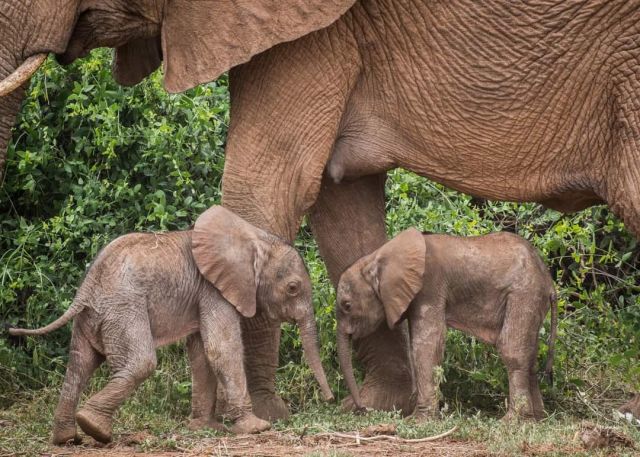
A thirty-year-old female elephant, Twain, a member of the TC elephant family and resident at the Kimana sanctuary, has given birth to twins. They were born on 7 October and, according to the Kenya Wildlife Service, represent the sixth pair of twins recorded in the Amboseli ecosystem. A rarity within a rarity, a small yet extraordinary event in a place that, in recent months, has had very little to celebrate.
Life, in short, has decided to turn up with two rather than one. We do not know whether it meant to spite the Grim Reaper or simply to remind us that all is not yet lost. But in a world where bad news often arrives with the punctuality of a utility bill and good news seems to require a miracle, two baby elephants are already news in themselves.
Of course, we mustn’t get carried away with our enthusiasm. Elephant twins are rare, and raising two is no walk in the park, even when you have four sturdy legs and a family willing to lend a hand. The mother must produce enough milk for both, feed herself properly and find a safe environment. The other females in the herd can help protect the calves, in keeping with that network of family solidarity that elephants have known about long before we invented conferences, symposia and campaigns on social cohesion.
In 2020, again in Amboseli, a female named Angelina gave birth to a pair of twins. The mother had struggled to produce enough milk for both of them, and the calves had become so weak that there were fears for their survival. Nature, therefore, does not guarantee happy endings. It offers possibilities, not assurances. And it accepts no complaints.
For Twain and her two calves, the hardest part begins now. They will have to grow up, find food, learn the family’s ways, recognise dangers and navigate a landscape that is no longer just one of savannahs, waterholes and acacia trees. It is also a landscape shaped by our needs, our greed and the consequences of our decisions – a place where we celebrate the resilience of wildlife, yet whose survival depends on our ability not to destroy it.
We like to think of Africa as a continent capable of healing our melancholy. We go there to see animals roaming free, to find a little peace and quiet, to delude ourselves that there is still a world where things follow an order older than our own contradictions. Then we discover that here, too, life is under pressure, that habitats are shrinking, that balances are being disrupted, and that even an elephant can fall victim to something it should never have encountered.
Yet nature persists. It makes the grass sprout after the rains, raises the trees back to their feet after the wind, and refills the waterholes when drought has dried them up. And every now and then, as in Kimana, it decides that a single birth is not enough and stages two.
It is not a definitive victory, it is not the redemption of humanity, nor is it even a fairy tale with a pre-determined ending. It is merely a possibility. But possibilities, when the world behaves like a cruel place, hold a value that we often forget.
Twain’s two calves know nothing of toxic fertilisers, convoluted investigations, the usual suspects or our fine debates on conservation. They do not even know that their birth has become a news story capable of shedding a little light on Amboseli. They know only that there is a mother to follow, a herd in which to find protection and a territory to learn.
For them, the world is still waiting to be discovered.
Lucky them.
We, on the other hand, already know enough to realise just how fragile it is, yet we carry on behaving as if it were indestructible. Then we’re moved by the sight of two baby elephants and convince ourselves, for a few minutes, that perhaps we’re not entirely beyond redemption.
Nature grants us this too: the chance to feel better than we really are.
So welcome, little twins of Amboseli. Grow, if you can. Grow up, if the world allows you to. Learn to walk in the red dust, to recognise the voices of your family, to drink from the waterholes and to follow in the footsteps of the adults.
We cannot promise you that humans will become wiser. That would be a reckless promise, and we already have enough trouble with the promises we cannot keep.
We can only hope that they will at least learn to let you live.
Because nature, poor thing, carries on doing its bit. Even when we do everything we can to make its job harder.
Such is life, such is this cruel world against which nature tries to rebel.


KENYA NEWS
by Freddie del Curatolo

Concerns continue to mount over the mysterious elephant die-off that has been affecting the Amboseli...
WILDLIFE
by redazione

Some of the most eminent international zoologists and conservationists called in a letter published in...
KENYA NEWS
by Freddie del Curatolo

For almost a month, it has been one of the most disturbing cases in wildlife conservation in Kenya. Since...
WILDLIFE
by redazione

The figures presented by ICEA, Lion General Insurance Company at the Kenya Wildlife Service are clear, this year has reached the 100 mark lions killed in the bush of Kenya.
NATIONAL PARKS
by Leni Frau

Amboseli National Park is one of Kenya's most popular parks and we can say that one of the ...
KENYA NEWS
by Freddie del Curatolo

The mystery deepens, but the solution seems to be drawing nearer and converging on a single...
WILDLIFE
by Freddie del Curatolo

Fourteen elephants have died in just three weeks. A massacre – a figure that has Kenya on edge...
WILDLIFE
by Leni Frau
From one of the most remote and fascinating national reserves of Kenya, Samburu, comes...
WILDLIFE
by redazione

Since the beginning of the year, a devastating phenomenon of wild animal poisoning has not...
SAVANNAH
by Leni Frau

One of Kenya's largest and most famous elephants, known as Tim, died yesterday at the age...

No tourists, more time and privacy to "have sex," but that's not all.
This...
ENVIRONMENT
by Freddie del Curatolo

Called "the safari lounge," Amboseli National Park is famous not only for giving the view of Kilimanjaro from...
ENVIRONMENT
by Freddie del Curatolo

NEWS
by Leni Frau

At least two families of elephants from Tsavo East and the Galana Conservancy have left the park...


