
EDITORIAL
07-11-2026 by Freddie del Curatolo
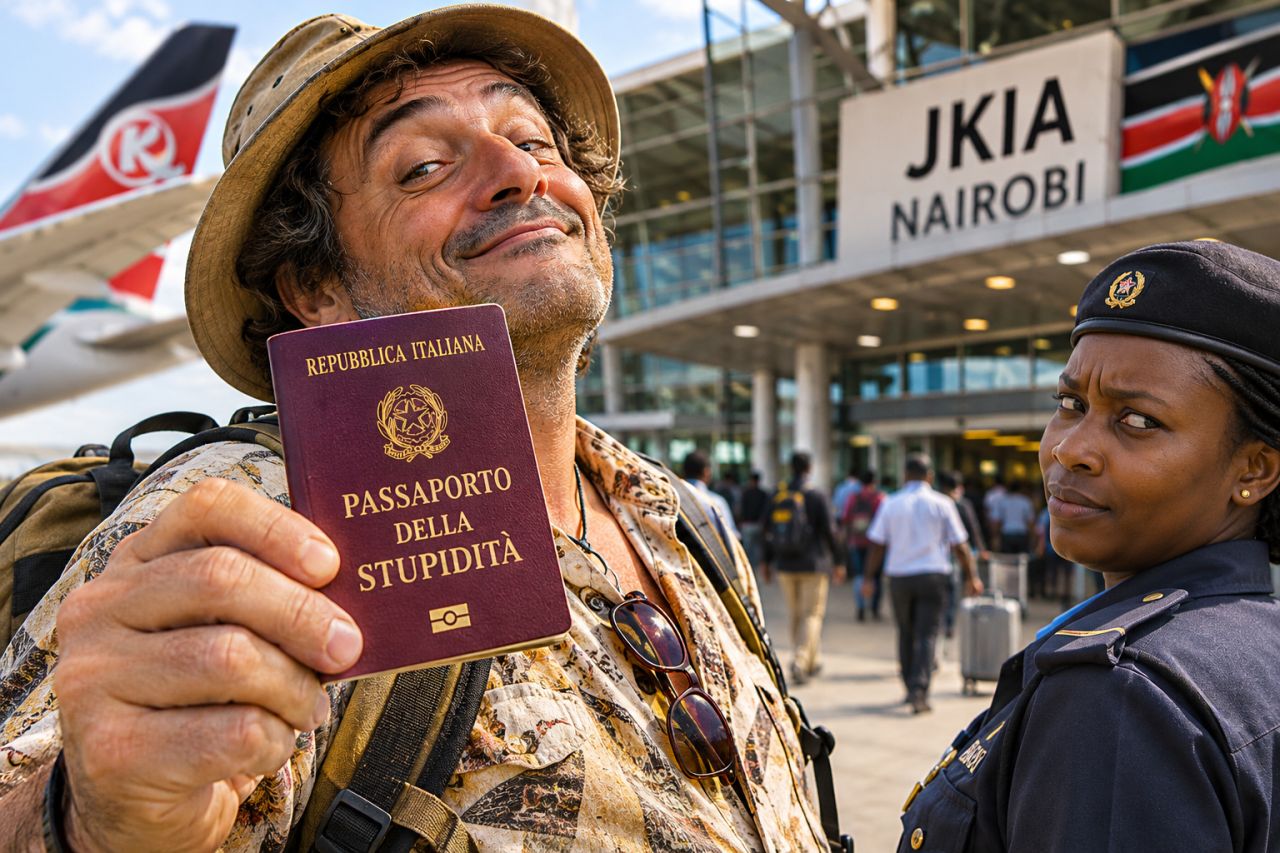
Kenya is a wonderful place to feel free. Especially for certain Italians who, as soon as they step off the plane, seem to forget not only the stress of work, the hectic pace of life, the rules and the bureaucracy, but also the highway code, a sense of moderation, the rules of social behaviour and, in some cases, even basic manners. Then, when that freedom takes an unexpected turn and the time comes to face up to local law, they remember they have an Italian passport. And that they pay taxes (if they actually do, but they certainly claim they do).
It’s a syndrome I know well, especially from the decades I’ve spent on the Kenyan coast, where the boundary between the tropical dream and everyday reality is often a fine line, drawn by the light of the Indian Ocean and erased, with surprising ease, by the arrogance of certain visitors.
In the imagination of some of our compatriots, Kenya is a sort of free zone of existence. A place where everything becomes simpler, more permissive, more uninhibited. Where the rules that seem indispensable to us in Italy are transformed into annoying relics of Western civilisation. Where you can do things you’d never do at home, or at least wouldn’t have the courage to do.
Three people on a boda-boda?
‘But everyone does it here.’
A night with a girl you met on the beach two hours earlier?
‘We’re in Africa, not Milan, where all it takes is a slightly forward approach and they’ll report you for harassment.’
Behaviour that in Italy would be deemed irresponsible, inappropriate or even illegal? ‘Come on, everything’s different here.’
The problem isn’t that Kenya is different. The problem is that certain Italians feel entitled to interpret that difference as a licence.
And this is where a form of ‘tourist resort’ neo-colonialism comes into play, which doesn’t necessarily need to manifest itself as explicit contempt for Africans, even if it often lurks beneath the surface and erupts at the first sign of misunderstanding. It’s more subtle, more domestic, even more ridiculous. It consists of thinking that a foreign country is a place where everything is at the visitor’s disposal: the sea, the landscape, the music, the people, human relationships, customs, even the rules.
As if the plane ticket and a few euros spent on holiday also bought temporary ownership of the land and its freedoms.
The great and much-missed Kenyan writer Ngugi wa Thiong’o taught us that the most enduring form of colonialism is that which survives in the mind. It is likely that certain Italians on holiday in Kenya have never read *Decolonising the Mind*. And they are unaware that they are unwittingly embodying one of its most bitter passages: that of those who continue to regard Africa as a place to be consumed, rather than a world to be respected.
The neo-colonial tourist is not necessarily the one who treats people badly – quite the opposite, in fact. Sometimes it is the one who regards them as an integral part of their own entertainment. Who feels entitled to intrude into their lives with a casualness they would never display at home. Who mistakes friendliness for absolute compliance, poverty for a lack of dignity, and cultural difference for an absence of rules. I often speak of this when I criticise the ‘sweets-based’ approach to charity, where children are used for selfies in exchange for a couple of toys or a kilo of rice.
But unfortunately, I also have to address it when it comes to news stories.
Perhaps it’s because I’ve lived here for so long, or perhaps it’s because I’ve experienced IT for so long. I always feel it’s important to remember that Kenya is a country. Not a playground for adults on holiday.
It has its own laws, its judiciary, its police force, its moral codes, its needs and its shortcomings. It has a complex history, a society that cannot be reduced to a photograph with palm trees in the background. And above all, it has a sovereignty that is not suspended when an Italian decides to treat their holiday as a permanent carnival.
The curious thing – and also a little disheartening – is that this sudden tropical anarchy has a very specific lifespan. As long as everything is going well, the Italian on holiday is a citizen of the world. He wants no constraints, no moralising, and doesn’t want to be told what he can or cannot do. He is cosmopolitan, non-conformist, free. They have discovered Africa and, along with Africa, a new version of themselves.
Then something happens.
A moment of carelessness turns into an incident. A chance encounter turns into a problem. Reckless behaviour comes to the attention of the authorities. Perhaps it turns out that what seemed like a simple prank is not regarded as such at all under local laws.
And so, as if by magic, the citizen of the world turns into a citizen of the Italian Republic.
The passport comes out. The Constitution is rediscovered. Rights are recalled. And, inevitably, the phrase comes out: “I pay my taxes; the embassy works with taxpayers’ money”.
If he does pay them, of course. But this is a detail that never seems to shake the certainty with which it is uttered.
“Italy must intervene”.
“The Foreign Ministry cannot abandon me.”
“I’m Italian; I have rights.”
There you have it: this is the ‘intermittent Italian’ syndrome. The person who, until the day before, behaved as if the rules were merely optional suggestions and who, as soon as they find themselves in trouble, demands to be assisted by the state with the speed of a helicopter and the discretion of a butler.
In such cases, the Motherland becomes a sort of diplomatic fire extinguisher. To be brought out only when the good life goes up in flames.
It would be easy – and also unfair – to dismiss all this with a laugh. But there is one point I feel compelled to emphasise, because in over thirty years of dealing with the institutions in this country, I have come to know and appreciate the work of Italian diplomacy, the Embassy and the consular offices.
Italy does not abandon its citizens; it never does.
Behind the stories that make the newspapers – and often behind those that do not – there are officials, diplomats and consular staff who work with discretion, care and professionalism, despite often being few in number and having to juggle numerous tasks. There are institutional contacts, checks, discussions with local authorities, and practical assistance for people finding themselves in difficult circumstances. This work is not always visible; it rarely produces immediate results and often has to navigate delicate balances.
Mind you, they are paid – and paid well – to do these things, but in this particular case, protecting a fellow citizen abroad is no diplomatic walk in the park. It is not enough to ring a minister, wave a flag or remind people that Italy is a friendly nation.
Above all, assisting a citizen does not mean being able to override the laws of another state.
The Ministry of Foreign Affairs is not a ‘good life’ debt collection agency. It is not a diplomatic taxi that turns up to pick up anyone who has mistaken freedom for impunity or who, out of naivety, has got themselves into a mess. It cannot take the place of the Kenyan judiciary, nor can it demand that international law be interpreted as a favourable clause for Italian tourists.
International law, moreover, is not an optional extra. And compliance with local laws is not a concession made to the host country out of kindness. It is an essential condition for coexistence between states.
This does not mean that the local authorities are always beyond reproach, that every proceeding is fair, that every charge is well-founded, or that every situation must be accepted without scrutiny. Consular protection also serves this purpose: to ensure that the citizen’s rights are respected, that they have access to the safeguards provided for, and that they are not left to fend for themselves.
Not least because I have met Italians who revel in being able to sort everything out in Kenya by ‘paying a bribe’ and, the moment that doesn’t work, become the fiercest critics of this corrupt system – clearly a wholly African phenomenon – which our government does nothing to combat or expose.
In short, there is a huge difference between defending a citizen’s rights and demanding that they be shielded from the consequences of their own actions.
And it is a difference that certain compatriots seem to discover only when their holiday comes to an end.
I wonder, with a certain sense of melancholy, whether the very same Italians who, in Kenya, indulge in behaviour they would not even consider normal in Italy, realise just how contradictory their attitude is. First, they assume the right to ignore the context, the laws and the sensitivities of the country they are in. Then, when the consequences catch up with them, they lash out at the Italian state, accusing it of not doing enough.
It is like expecting to play a match by one’s own rules, only to call on the referee when one realises the pitch belongs to someone else.
Paradise, evidently, does not grant diplomatic immunity.
And perhaps it would be wise to bear this in mind before three of you pile onto a boda-boda, before turning a beach into a market of illusions, before assuming that every encounter is a courtesy and every freedom a licence. In short, before setting off.
Because travelling does not merely mean changing your latitude. It also means accepting that the world was not built around our habits, our desires and our comforts. Africa does not exist, as I always say, and all the more so, it is not a place where you can do as you please. It is a vast and diverse continent, and Kenya is a nation, with millions of people living, working, suffering, hoping and trying to build their own future. They are not mere extras in a Western holiday.
The Italian state, quite rightly, supports its citizens. It does so out of duty, not out of sympathy. And it should go without saying that this duty does not absolve each individual from the responsibility to behave responsibly. Freedom does not mean doing whatever takes your fancy until the moment someone calls you to account for what you have done.
And the Italian passport, however prestigious and valuable it may be, is not a free pass for stupidity.
Paradise may well be beautiful. But when you decide to live there, even for just a week, it would be wise to remember that it is not our home.
And that, above all, it is not up to us to set the rules or demand that they be changed to suit the daft things we get up to.


KENYA NEWS
by Freddie del Curatolo

Diani Beach, a swimming pool, a death yet to be clarified and a passport being withheld. It is a
INSTITUTIONS
by redazione

Malindikenya.net informs all compatriots on holiday in Malindi and in the towns of Kilifi County that...
INSTITUTIONS
by redazione

The consulate is a point of contact for Italian citizens abroad, but it is not an authority capable of overturning...
ITALIAN CONSULATE MALINDI
by redazione

When an Italian citizen is in an emergency situation (such as a tourist in transit has to start and has lost or was robbed of his passport) and he's not in time to institute the necessary investigation for the issuance of a new...
ITALIAN EMBASSY
by redazione

The Italian Embassy in Nairobi informs that as of 15 July 2024, Italians registered with AIRE in...

Electronic Passport from 1 September for Kenyan citizens.
The Kenya Immigration Office has announced that at the end of this month it will no longer be possible to apply for a passport valid for expatriation with the methods used to...
REFERENDUM
by redazione
On June 12, 2022 the Italians will vote on five popular referendums that particularly...

Italian residents in Kenya registered with AIRE still have one week left...

Almost all Westerners who visit Kenya do so on holiday.
It may be an...

Eight months more time for Kenyan citizens to convert their old passport to the...


